
Anderson County Court Records After a Jail Arrest
After an arrest in Anderson County, the first record is usually the jail booking or commitment record kept through the Anderson County Sheriff's Office. The formal court record begins when the Anderson County Attorney reviews the law-enforcement report and files a criminal, traffic, juvenile, or related case in the 4th Judicial District. The County Attorney is Steven R. Wilson, with Assistant County Attorney Wade H. Bowie II, and the prosecutor office is at the Anderson County Courthouse, 100 East 4th Street, P.O. Box 367, Garnett, KS 66032. The prosecutor office phone is 785-448-5703, and the posted hours are Monday through Friday, 8:00 a.m. to 5:00 p.m., with lunch from noon to 1:00 p.m.
The custody side and the court side should be read separately. For current custody, booking intake, and jail-calendar information, use jail inmate records and contact the sheriff at 135 East 5th Avenue, Garnett, KS 66032. For booking photos, use jail mugshots, because Kansas guidance treats mug shots differently from ordinary docket information. For court records after an arrest, the key question is what the prosecutor actually filed and how the district court docket describes the case.
The Anderson County District Court is part of Kansas's 4th Judicial District. The court page lists District Judge Eric W. Godderz, Magistrate Judge Kara L. Reynolds, Clerk of the District Court Tina Miller, address 100 E. 4th, Garnett, KS 66032, phone 785-448-6886, and public hours Monday through Friday from 8:00 a.m. to noon and 1:00 p.m. to 4:00 p.m. Anderson County court information may appear on a 4th Judicial District page hosted under Franklin County's website because Anderson, Coffey, Franklin, and Osage counties share that district structure.
How to Find Anderson County Court Records After an Arrest
Kansas District Court Case Search is the public starting point for filed district court cases. Its official search modes include case number, party name, business name, citation, and role-based criteria. For an Anderson County criminal matter, a docket may show a caption such as State of Kansas versus the defendant, the party role, attorney, judge, hearing date and time, case number, event type, and appearance mode. Anderson criminal case numbers in the research sample used an AN-year-CR-number pattern, such as AN-2026-CR-000027.
- Open Kansas District Court Case Search and choose the search mode that matches the information available.
- Search by defendant name when no case number is known, or use an Anderson County case number in the AN-year-CR-number format when it is available.
- Open the public case result and read the caption, filed charge entries, attorney information, judge assignment, and next event.
- Compare each filed charge with the jail booking allegation, because the court charge may be different, amended, dismissed, or resolved later.
Use the court clerk when the online case search does not answer the question. Courthouse terminal access and clerk-assisted record access can matter when a case is newly filed, when a public docket entry is hard to interpret, or when a traffic citation or municipal matter has moved into district court. Garnett Municipal Court matters can intersect with Anderson County District Court through appeal or related filings, so the county court search is still useful even when the original police contact was city-level.
The official Kansas Case Search screen is available from the Kansas Judicial Branch at casesearch.kscourts.gov.
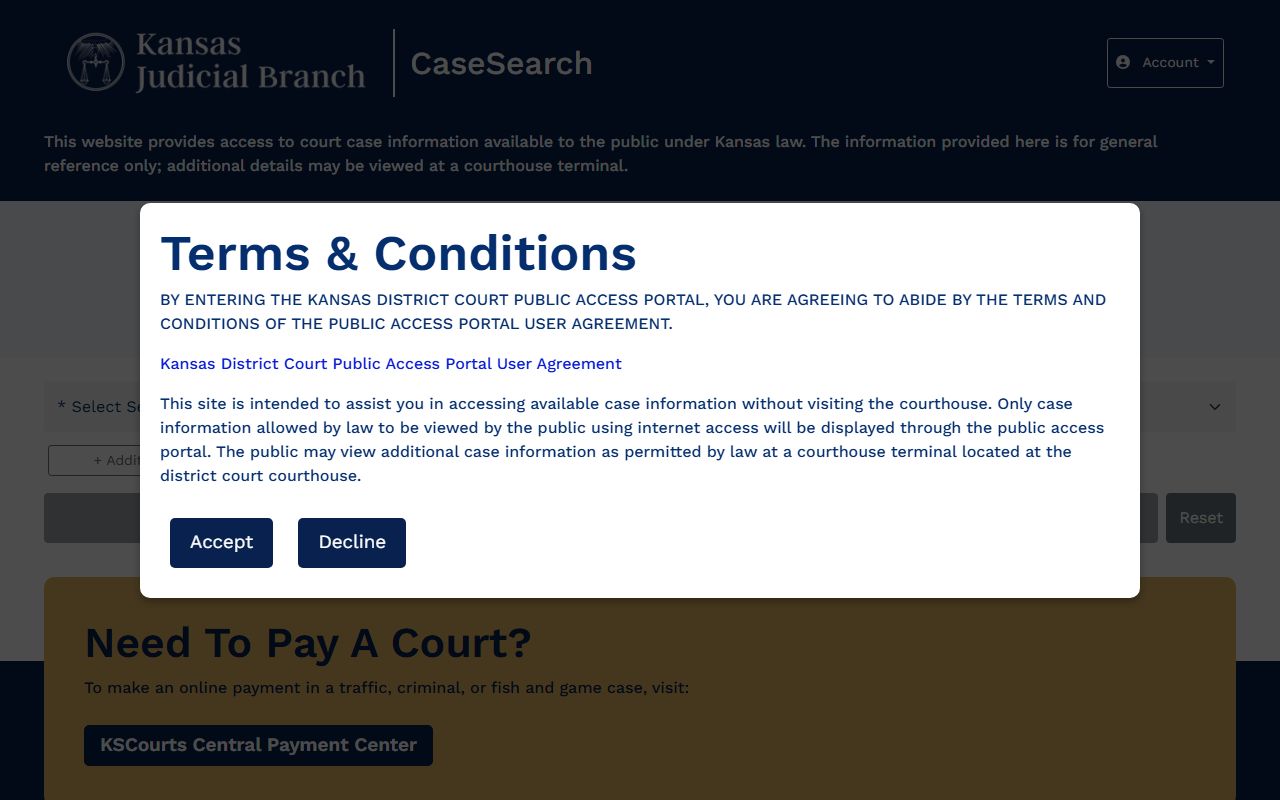
That search portal is for filed court records. It is not a live jail roster and does not replace a direct custody inquiry to the Anderson County Sheriff's Office.
Charge Filing After Arrest
A jail arrest usually starts with law enforcement booking a person into Anderson County Jail or committing the person to the sheriff's custody. Booking records can list an arrest charge or hold, but that entry is not the same thing as the court record. The court charge record begins when the prosecutor files a charging document. The charging document may be a complaint, an information, or an indictment, depending on the route used in the case.
| Complaint | Information | Indictment | |
|---|---|---|---|
| Filed By | Usually a prosecutor, sometimes tied to officer-submitted facts | Prosecutor | Grand jury process |
| Common For | Initial criminal filing and many routine matters | Prosecutor-filed charges after preliminary procedures or review | Less common locally; used when a grand jury returns charges |
| Starts | The public court case when accepted for filing | The formal prosecution in court | The prosecution based on grand-jury action |
That filing decision is why court records after a jail arrest may not mirror the first custody note. A person can be booked on one description, then charged under a different statute, charged with fewer or additional counts, not charged, or transferred because another agency has the controlling hold.
Anderson County Charge Status
Charge status is the running condition of each filed count in the case. Anderson County docket entries may show hearings such as arraignment, status conference, motion, court review, or other events, with appearance modes such as in person, Zoom, paper only, or no-appearance review notes. The status of a charge can change as the prosecutor, defense, and court address evidence, plea discussions, motions, warrants, and sentencing.
| Status | What It Means |
|---|---|
| Pending | The charge remains unresolved and future hearings or filings are expected. |
| Amended / Reduced | The prosecutor or court record reflects a changed count, level, description, or negotiated replacement charge. |
| Dismissed | The court record shows the count or case was dismissed; the arrest and booking record may still exist unless later expunged. |
| Nolle Prosequi | The prosecutor declines to continue that prosecution or count, subject to how the docket records the disposition. |
Bond and Release After an Arrest
Anderson County did not publish a detailed local bond page in the researched sources, so bond questions should be confirmed with the sheriff or the district court clerk. Bond can be set by a judge at first appearance, by a warrant order, or through a local process not published online. Call the Anderson County Sheriff's Office at 785-448-5678, or dispatch at 785-448-5428 for time-sensitive routing, and ask who controls the bond, where payment must be made, what payment types are accepted, and whether another hold blocks release.
| Bond Type | How It Works |
|---|---|
| Cash Bond | The required money is paid as directed by the jail or court, subject to local payment rules. |
| Surety Bond | A bail agent or surety may post bond where permitted, often for a fee or collateral. |
| PR / Own Recognizance | The person is released on a promise to appear and follow conditions rather than paying the full cash amount. |
| No-Bond Hold | The person cannot be released on ordinary bond until the court or holding agency changes the status. |
A detainer or hold from another county, KDOC, parole or postrelease supervision, a federal agency, or immigration authority can keep someone in custody even when the Anderson County court record shows a bond on one charge.
Warrants That Lead to an Arrest
No official Anderson County active-warrant web search was located. The county departments page says the sheriff serves warrants and court papers, files and serves protection orders, transports and incarcerates prisoners, and assists agencies such as Garnett Police Department, Kansas Highway Patrol, and KBI. A warrant arrest can therefore create both a jail record and a court record, but the online path is not a county warrant list.
For warrant-related court records after an arrest, search Kansas Case Search by party name or case number and contact Anderson County District Court at 785-448-6886 for bench-warrant case status. Contact the sheriff at 785-448-5678 for warrant-service and custody questions. Court staff can provide public record routing, but they cannot give legal strategy to a person who may have an active warrant.
Charges vs. Convictions
An arrest or filed charge is not a conviction. It is an accusation or procedural status in the court record. A conviction occurs only after a guilty plea, no-contest plea accepted by the court, trial verdict, or other disposition that the court records as a conviction. This distinction matters when reading Anderson County court records after a jail arrest because a public docket can show pending charges long before a final outcome exists.
| Charge | Conviction | |
|---|---|---|
| Stage | Accusation filed by the prosecutor | Final or accepted outcome after plea or trial |
| Burden of Proof | Lower threshold for filing and proceeding | Beyond a reasonable doubt for trial conviction |
| Public Record | Often public unless sealed, restricted, juvenile, or otherwise closed | Often public unless later sealed, expunged, or restricted by law |
Sealed vs. Expunged Arrest Records
Kansas law includes expungement paths for certain convictions, arrest records, and diversion agreements under K.S.A. 21-6614, and a separate arrest-record expungement statute at K.S.A. 22-2410. Eligibility depends on the case type, disposition, waiting periods, and statutory exclusions. A dismissed Anderson County charge does not automatically erase the booking or case record from every system.
| Sealed | Expunged | |
|---|---|---|
| Visibility | Public access is restricted for the covered record. | The record is treated as expunged under the controlling Kansas statute. |
| Law Enforcement | Some official access may remain depending on the record and order. | Access and disclosure rules depend on the expungement statute and court order. |
| Eligibility | Depends on the case category and court order. | Depends on K.S.A. 21-6614, K.S.A. 22-2410, disposition, timing, and exclusions. |
Background Check Considerations
Casual court-record searches are not the same as a compliant employment, tenant, insurance, credit, or licensing background check. Anderson County court records after an arrest may be incomplete, newly amended, sealed, expunged, or limited by public-access rules. Anyone making a formal eligibility decision should use a legally compliant screening process and verify the source record with the court or originating agency.
Important: This website is not a consumer reporting agency and may not be used for FCRA-covered decisions.
Restricted Anderson County Court Records
Kansas Open Records Act access is broad, but it is not unlimited. K.S.A. 45-221 lists categories of records that are not required to be disclosed, and the law calls for separation of open and closed information when possible. Juvenile matters, sealed entries, restricted family or dependency items, active investigative material, protected victim information, and expunged records may be withheld or redacted.
The official Anderson County District Court contact page is available through the 4th Judicial District at franklincoks.org/331/Anderson.
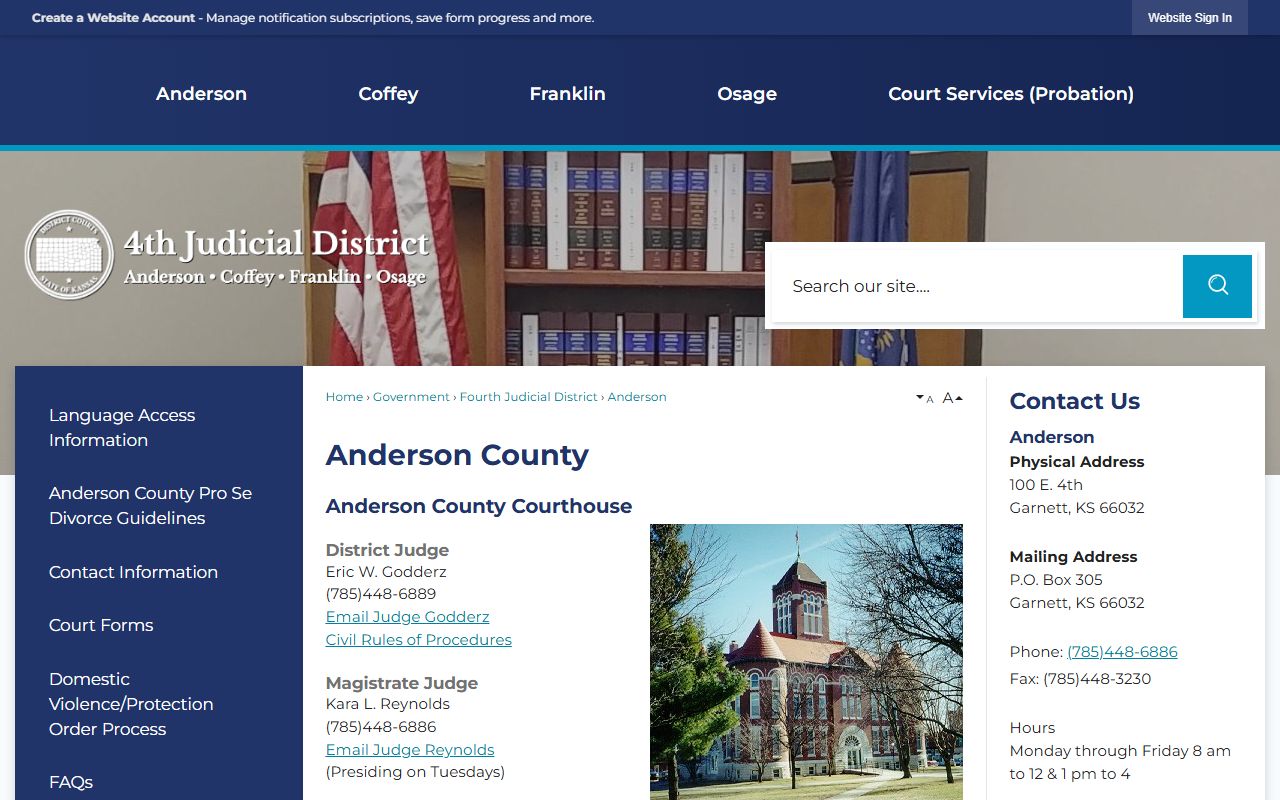
The district court contact is the practical fallback when a Kansas Case Search result is unclear, missing, sealed, or too new to interpret from the public portal alone.